
Are You Driving Blind? Why a Vulnerability Portal is the Way to Drive Forward.
Most people wouldn’t dream of skipping their car’s MOT. Yet every day, organisations operate their entire digital infrastructure with no idea what’s quietly breaking down underneath the bonnet. Now is the time to change that.
The MOT Analogy That Your Organisation Needs to Think About
Think about your car’s MOT. You take it in, it passes, and you drive away with a certificate and a sense of relief. But what happens the next day? A brake pad begins to wear, a sensor starts to fail or a small crack in a component begins to spread.
Now, you probably won’t even know about it, not until the next MOT or until disaster strikes and something goes seriously wrong on the road.
Your company’s IT infrastructure works in exactly the same way. A one-off security audit might tell you everything looks fine today. But vulnerabilities don’t wait for scheduled reviews. They emerge constantly, through new software releases, misconfigurations, evolving attack techniques, and the ever-changing threat landscape of the internet. The moment your last assessment is complete, the clock is already ticking on the next unknown risk.
The question isn’t whether new vulnerabilities will appear because, they will. The question is: will you know about them before an attacker does?
What Is a Vulnerability Portal and Why Does It Matter?
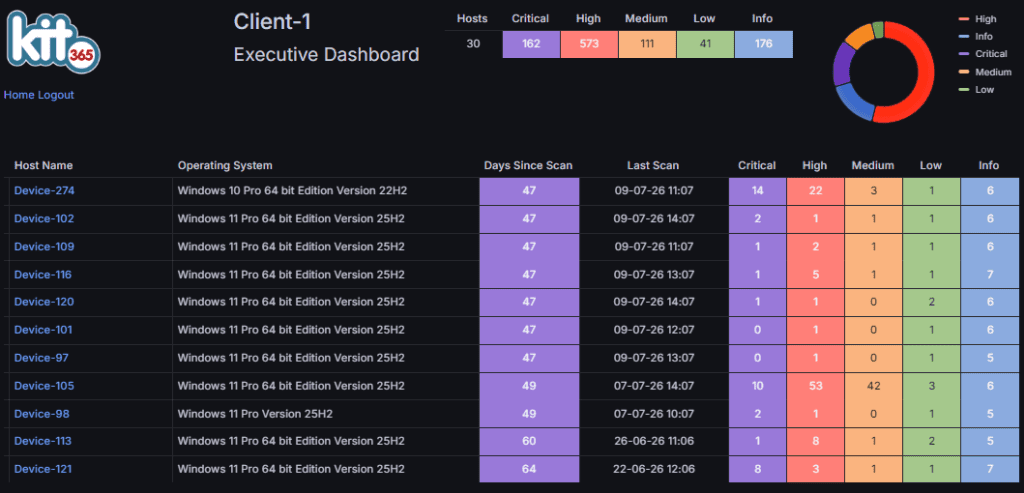
A vulnerability portal is a centralised, real-time platform that continuously monitors your systems, collects incoming threat intelligence, and surfaces security weaknesses as soon as they are detected. Rather than relying on periodic snapshots of your security posture, a vulnerability portal gives your team a live, ongoing view of exactly what needs attention and when, so that nothing is left to chance.
It’s a bit like a continuous MOT but one that never stops running.
Instead of discovering a critical flaw six months after it first appeared, your team is alerted the moment it becomes known. Instead of patching in a panic after a breach, you’re working proactively on your terms.
It’s a problem KIT365 have seen time and again working with organisations of all sizes.
That experience is part of what led us to develop our own vulnerability portal, a tool built around the practical realities of how IT teams actually operate. It is designed to surface what matters most without overwhelming the people responsible for acting on it.
The 14-Day Patch Window and Why Speed Is Everything
When a new vulnerability is disclosed, whether it’s a zero-day exploit, a software flaw, or a misconfiguration, the race begins immediately. Threat actors scan the internet for exposed systems, often within hours of a vulnerability becoming public knowledge.
Industry best practices identify 14 days as the critical patching window for high and critical-severity vulnerabilities. Organisations that consistently patch within this timeframe dramatically reduce their exposure and their risk of a successful attack. As the saying goes, ‘prevention is better than cure.’
But hitting that 14-day window is only possible if you know about the vulnerability in the first place.
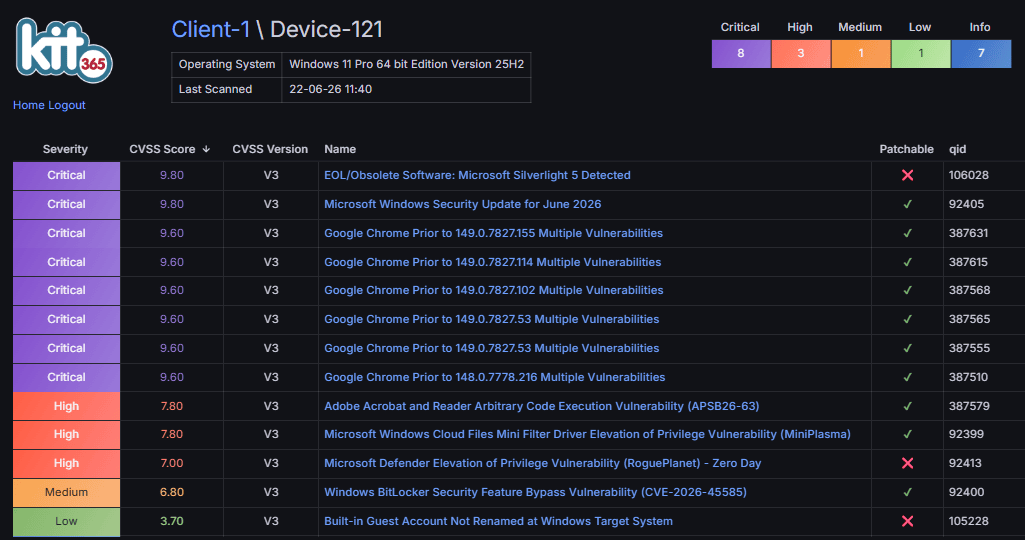
Without a vulnerability portal, your team is relying on manual processes, vendor email alerts, and periodic scans, all of which introduce delay. By the time a vulnerability reaches the right person, is triaged, prioritised, and actioned, those 14 days can slip by with alarming speed.
A vulnerability portal removes that delay. It captures the threat, classifies it, and puts it in front of the right team, immediately giving you the full 14 days to respond effectively rather than scrambling to catch up.
The Real Cost of Not Knowing
If you ignore a problem identified at your MOT, you’re taking a calculated risk every time you drive. At some point, the brakes fail, the tyre blows, or the engine cuts out, and the consequences can be devastating, far more costly than the repair would ever have been.
Now consider the equivalent in your business:
- A single unpatched vulnerability can serve as the entry point for ransomware that encrypts every file across your network.
- A misconfigured server left undetected can expose customer data, triggering regulatory fines and reputational damage that takes years to recover from.
- A loophole in your infrastructure, one you didn’t know existed, can be exploited to take your entire network offline, halting operations, destroying customer trust, and haemorrhaging revenue by the hour. There have been some prime examples of this with some well known household names over the last couple of years such as Marks and Spencer’s and Jaguar Land Rover, to name a few.
Can your business afford that?
- A single unpatched vulnerability…
- A misconfigured server…
- A loophole in your infrastructure…
The downtime, the recovery costs, the legal exposure or the reputational damage. The price of not knowing is always higher than the cost of finding out.
Can you afford not to know?
Visibility Is Not Optional, it’s Imperative
The organisations that will thrive in the current threat environment are not necessarily those with the largest security budgets or the biggest teams. They are the ones with the best visibility.
Knowing what is vulnerable, knowing it quickly, and acting on it within that critical 14-day window is one of the most effective things any organisation can put in place to protect itself.
A vulnerability portal makes that possible. It transforms your security posture from reactive to proactive, from driving blind to having a clear view of the road ahead.
Let’s not wait for our car to break down before looking under the bonnet!
The Vulnerability Portal
At KIT365, we’ve built our vulnerability portal to give organisations exactly that kind of ongoing visibility that is practical, clear, and built for teams who need to act fast. If you’d like to understand more about how continuous vulnerability monitoring could work for your business, get in touch for a quotation or free 30-minute cyber consultation.